Guide
Lightning Mud Flaps vs Ford OEM Splash Guards: Which to Buy
Two ways to stop rocker-panel spray on an F-150 Lightning — an aftermarket no-drill ABS set or Ford factory splash guards with published part numbers. How they differ.
There are two credible ways to keep road spray, salt, and stone chip off an F-150 Lightning's rocker panels and lower doors, and they sit at opposite ends of the aftermarket-versus-factory spectrum. One is an aftermarket four-piece no-drill ABS set. The other is Ford's own splash guard kit, identified by published part numbers. They solve the same problem differently, and the right answer depends on how long you are keeping the truck and how much you care about part-number traceability.
This guide compares them on fitment coverage, install reality, and what each one actually claims.
Side by Side
| Aftermarket no-drill flaps | Ford OEM splash guard kit | |
|---|---|---|
| Pieces | Set of 4, front and rear arches | Front and rear kit |
| Material | ABS | Factory kit |
| Stated years | 2022-2025 | 2022-2026 |
| Part traceability | None published | NL3Z-16A550-AA front, NL3Z-16A550-BA rear |
| Install | Medium, described as no-drill | Medium |
The Aftermarket Option
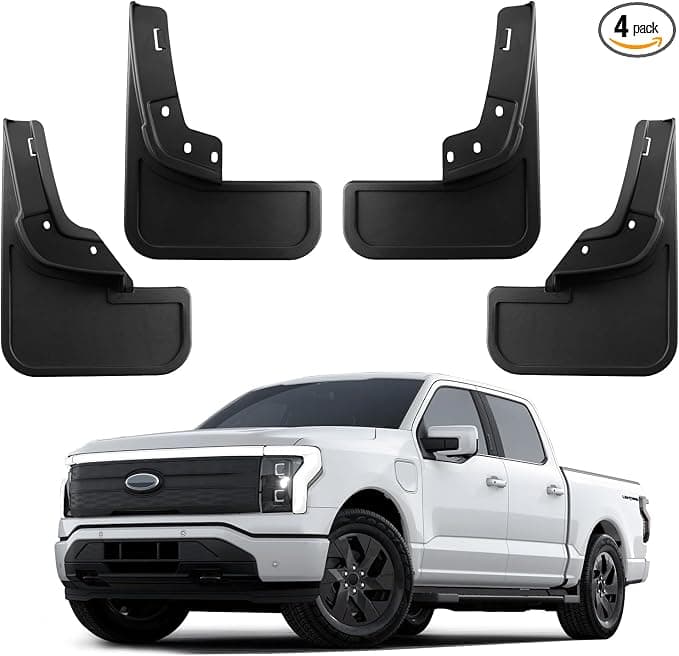
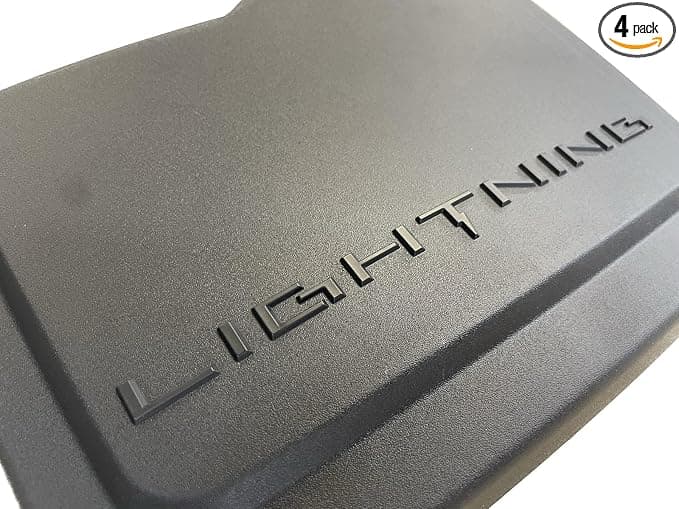
The Lightning no-drill mud flaps are a four-piece wheel-arch splash guard set shaped for the F-150 Lightning, listed for model years 2022 through 2025, in ABS.
Two notes from the fitment record. First, the seller describes installation as no-drill, and the catalog records that as the seller's description rather than a verified guarantee — the note says to confirm the included hardware. That distinction matters because no-drill designs work by reusing existing fender liner fasteners, and whether that goes smoothly depends on what arrives in the box and on the condition of the fasteners already in your truck. Second, and more importantly for buyers of newer trucks: the stated range ends at 2025, and the catalog note says to confirm 2026 fitment separately. If you have a 2026 Lightning, this set has not claimed your truck.
On the material: ABS is a rigid plastic. Rigid flaps hold their shape and look tidier along the arch line, but they are less forgiving than flexible TPE or rubber when they meet a snowbank, a high kerb, or a deep rut — a rigid flap tends to crack or break its mounting where a flexible one deflects and recovers. For a truck that mostly sees paved roads, that is a non-issue. For a truck that gets used off pavement, it is worth knowing.
The Factory Option
The Ford Lightning OEM splash guard kit is a front and rear factory kit, listed for Lightning model years 2022 through 2026 — a range that, unlike the aftermarket set, covers current trucks without a separate question.
Its distinguishing feature is traceability. The catalog records NL3Z-16A550-AA for the front and NL3Z-16A550-BA for the rear, and the fitment note says to confirm those part numbers against your vehicle's build. That is a meaningfully different buying experience from an aftermarket listing:
- You can verify against your build rather than against a marketing title. A part number either applies to your truck or it does not, and a Ford parts counter can confirm it from your VIN.
- Fit is to factory tolerance and mounting points by design, because it is the part the vehicle was engineered to accept.
- It resolves the resale and lease question. Factory accessories with real part numbers do not raise the questions an unbranded ABS set can at turn-in.
The catch is that part numbers vary by build. That is exactly why the fitment note tells you to confirm them rather than assume them — a kit correct for one Lightning configuration is not automatically correct for another, and here you have the tools to check properly instead of guessing.
How to Choose
Choose the factory kit if you have a 2026 truck, you want part-number-level certainty, the truck is leased, or you plan to sell it and would rather have OEM accessories on the window sticker than aftermarket ones. The traceability is the product.
Choose the aftermarket set if your truck is within 2022 through 2025, you are keeping it, and you want the cheaper route to the same outcome. Four pieces covering both axles is complete coverage, and ABS on a paved-road truck will do the job for years.
Choose neither yet if your truck is a 2026 and you want the aftermarket set specifically — ask the seller about 2026 fitment first rather than ordering on the assumption that a range ending at 2025 nearly reaches you.
What Splash Protection Actually Buys
Worth being honest about the size of the effect, because both products are sometimes oversold.
What you get: materially less spray and stone strike along the rocker panels and lower doors, less salt carried into the wheel wells, and less grit thrown up to be tracked into the cabin. On salted winter roads and gravel, this is real corrosion and paint protection, and it is cumulative — the benefit is measured over seasons, not drives.
What you do not get: a dry truck. Flush-mounted flaps and factory splash guards both sit relatively close to the body compared with the large, standoff rubber flaps you see on work trucks. They reduce spray; they do not eliminate it. Anyone expecting a clean lower body after a wet drive will be disappointed by either product.
The secondary benefit is interior, and it pairs with the rest of a Lightning setup. Less grit reaching the body means less reaching the footwells and the frunk, which is why we would fit flaps before or alongside the floor liners covered in our cabin protection guide.
Installing Either One
Both are rated Medium in our catalog, and for the same reason: the work happens behind the fender liner, where fasteners are hidden, sometimes seized, and easy to break.
The sequence is broadly the same whichever kit you buy. Turn the wheel to full lock to open up access to the arch. Locate the existing fasteners along the liner edge — usually a mix of screws and push-in clips. Remove only the ones the instructions call for, because a fender liner held by fewer clips than it needs will flutter at speed and eventually tear at the remaining points.
Three things that turn an hour into an afternoon:
- Broken clips. Plastic push clips that have been through a few winters snap rather than release. Have a few spares on hand before you start, in the size your instructions specify. This is the single most common reason a "no-drill" job stalls.
- Seized screws. Penetrating fluid and patience beat force. A stripped head in a fender liner is a much longer job than the one you started.
- Test fitting. Offer the flap up and confirm every hole lines up before driving a single fastener. Flaps that are close but not aligned end up cross-threaded or forced, and forcing rigid ABS is how it cracks at the mounting boss.
Torque matters less than seating here — these are plastic parts into plastic clips, not structural fasteners. Snug and fully seated, not tight.
Timing
If you live where roads are salted, fit whichever you choose before the first storm of the season rather than after it. Salt spray into wheel wells and along rockers does more visible harm in one winter than a year of dry driving, and the whole value proposition of these parts is preventative. There is no version of this purchase that repairs damage already done.
Before You Buy
- Confirm 2026 fitment with the seller before ordering the aftermarket set; its stated range ends at 2025.
- Confirm part numbers NL3Z-16A550-AA and NL3Z-16A550-BA against your build before ordering the factory kit.
- Confirm the included hardware on the no-drill set before starting the install.
- Prefer the factory kit on a leased truck or one you plan to sell.
- Expect meaningful spray reduction rather than elimination from either product.
- Fit before winter, not after; this is preventative protection only.
- Keep sensors, cameras, and safety labels clear when mounting anything to a wheel arch.
- Per-product fitment notes live on the F-150 Lightning accessories hub.
Last updated: August 2026
EV Drip may earn a commission if you buy through links on this page, at no extra cost to you. Our editorial work is research-based unless a page documents a hands-on test.
Frequently Asked Questions
Should I buy aftermarket mud flaps or Ford OEM splash guards?
Choose the factory kit if you have a 2026 truck, want part-number certainty, or the truck is leased or headed for resale — traceability is the product. Choose the aftermarket four-piece set if your truck is within 2022 through 2025, you are keeping it, and you want the cheaper route to the same outcome.
What are the Ford Lightning OEM splash guard part numbers?
The reviewed kit is cross-referenced to NL3Z-16A550-AA for the front and NL3Z-16A550-BA for the rear, listed for model years 2022 through 2026. Part numbers vary by build, so confirm them against your vehicle — a Ford parts counter can verify from your VIN, which is a meaningfully better check than a marketing title.
Do the aftermarket Lightning mud flaps fit a 2026 truck?
The stated range ends at 2025, so 2026 fitment should be confirmed with the seller separately rather than assumed. The factory splash guard kit's range runs to 2026 without a separate question, which is one reason to prefer it on a current truck.
Is ABS or flexible rubber better for mud flaps?
ABS is rigid, so it holds its shape and looks tidier along the arch line, but it is less forgiving than flexible TPE or rubber when it meets a snowbank, a high kerb, or a deep rut — rigid flaps tend to crack or break their mounting where flexible ones deflect and recover. For a mostly-paved truck it is a non-issue.
Related Products
EV parts deals & new guides
Optional EV parts deals and buying guides. Unsubscribe anytime.
By subscribing you agree to our Terms and Privacy Policy.